

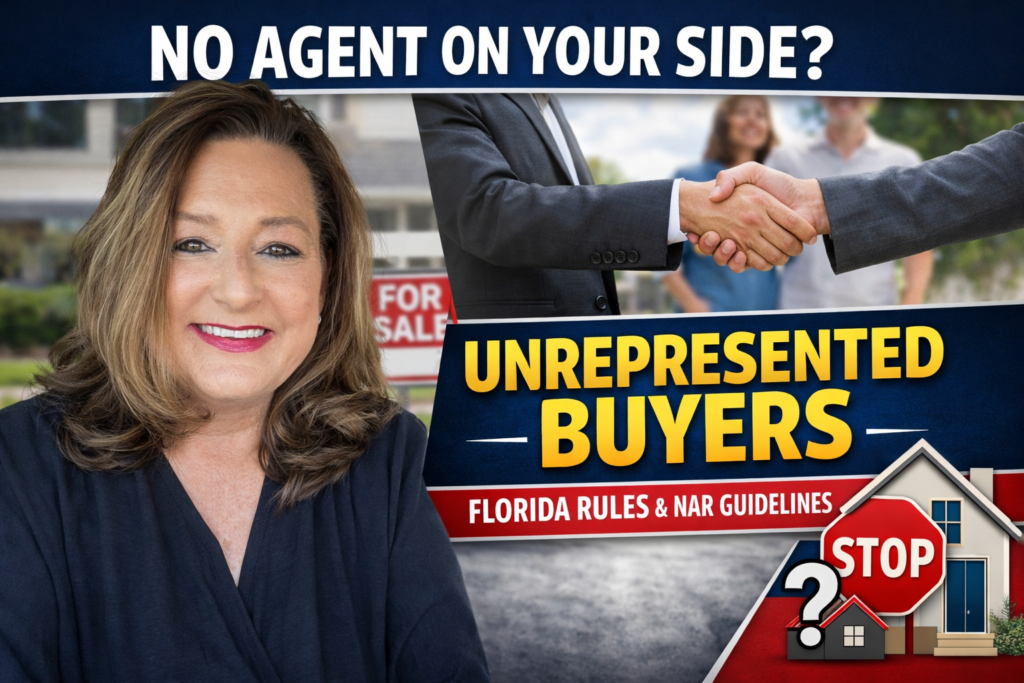
Understand Florida rules for unrepresented buyers and why having your own real estate agent protects your interests when buying a home.
Florida Rules for Showing a Listing to an Unrepresented Buyer
By Kim Donahue | Real Estate Expert Advisor, Your Realtor with a Heart to Serve.
Buying or selling a home is one of the largest financial decisions most people will ever make. Yet in today’s shifting real estate landscape, more buyers are walking into transactions without representation, believing it might save them money.
In reality, it often does the opposite.
Recent industry changes following the National Association of Realtors Settlement have created new rules about buyer representation, compensation transparency, and agency relationships. While these changes are meant to provide clarity, they have also created confusion — especially for buyers who believe they can simply call the listing agent and represent themselves.
Before you do that, it’s important to understand the rules in Florida Real Estate Law and what a listing agent can — and cannot — legally do for an unrepresented buyer.
Understanding these boundaries protects everyone involved in the transaction.
A Quick Story From the Field
Not long ago, a buyer contacted me directly about one of my listings. They believed working directly with the listing agent would give them an advantage.
Their thought process was simple:
“If I don’t have my own agent, maybe the listing agent will help me get a better deal.”
It sounds logical — until you understand agency law.
The moment a buyer begins asking questions about price strategy, negotiations, or offer structure, the listing agent must immediately pause. At that point, the conversation moves into areas where representation is required.
Why?
Because the listing agent already has a legal duty to protect their seller.
That duty cannot be split in half.
What a Listing Agent Can Do for an Unrepresented Buyer
If a buyer contacts a listing agent directly, the agent can still perform limited actions.
These actions fall under what Florida calls transaction brokerage or ministerial acts.
A listing agent may:
• Schedule and conduct a showing of the property
• Provide factual information about the property
• Share publicly available documents (HOA rules, disclosures, surveys if available)
• Answer general property questions
• Provide the listing price and basic property details
• Explain required forms for submitting an offer
However, the listing agent must always disclose that they represent the seller and not the buyer.
What a Listing Agent Cannot Do Without a Representation Agreement
Where things become more restricted is when the conversation shifts from information to advice.
Under Florida law and the post-settlement rules, the listing agent cannot begin advising a buyer without entering into a formal representation agreement.
This includes things like:
• Writing or structuring an offer on the buyer’s behalf
• Recommending offer price strategies
• Advising on negotiation tactics
• Providing a comparative market analysis for the buyer
• Advising on inspection strategies
• Recommending vendors such as lenders, inspectors, or contractors
• Explaining how to structure concessions or closing costs
• Protecting the buyer’s negotiating position
Once those conversations begin, a Buyer Broker Agreement must be signed if the agent is going to represent that buyer.
Without that agreement, the agent is limited to neutral information only.
When a Representation Agreement Is Required
A Buyer Representation Agreement becomes necessary when the buyer asks the listing agent to begin acting in their interest.
Examples include:
• Asking the listing agent to write the offer
• Requesting pricing advice or negotiation guidance
• Asking for recommendations on lenders or inspectors
• Requesting contract interpretation
• Asking for market analysis to determine value
At that point, the agent must either:
- Remain the seller’s agent only, or
- Enter into transaction brokerage, or
- Establish buyer representation through a signed agreement
Each option carries different legal responsibilities.
Why Buyers Should Avoid Going Unrepresented
Many buyers believe going unrepresented will give them an advantage.
In reality, it removes the one person legally responsible for protecting their interests.
Think about the dynamics of a transaction.
The builder’s sales representative works for the builder.
The listing agent works for the seller.
Neither party represents the buyer unless an agreement exists.
Their job is to secure the best possible outcome for the party they represent.
That means:
• The highest possible price
• The strongest contract terms for the seller or builder
• The fewest concessions
Without representation, the buyer is negotiating against professionals whose legal duty is to someone else.
New Construction Buyers: The Biggest Misunderstanding
This misunderstanding is even more common in new construction.
Buyers often assume the builder’s sales representative is there to help them.
But the reality is simple.
The sales representative works for the builder.
Their role is to:
• Protect the builder’s profit margins
• Secure the highest possible price
• Move inventory efficiently
They are not negotiating on behalf of the buyer.
Having your own agent costs the buyer nothing in most new construction transactions, yet it provides an advocate who can:
• Negotiate incentives
• Compare builders and communities
• Review contract terms
• Protect deposits
• Coordinate inspections
• Help navigate design center upgrades
Without that advocate, buyers are negotiating directly with the seller’s representative.
The Truth About “Saving Money” by Going Direct
Some buyers believe they can save money by going directly to the listing agent.
But real estate commissions are negotiated between brokerages — not eliminated simply because a buyer shows up alone.
What buyers often lose instead is:
• Strategic negotiation
• Market value guidance
• Contract protection
• Inspection advocacy
• Professional representation during the entire transaction
That protection is often worth far more than buyers realize.
The Bottom Line
The rules today are designed to make agency relationships transparent.
But transparency also means responsibility.
If you are buying a home in Florida, having professional representation ensures someone at the table is legally obligated to protect your interests, guide your decisions, and negotiate on your behalf.
And that peace of mind matters.
Especially in one of the largest financial transactions of your life.



This web site really has all the information I wanted concerning this subject
and didn’t know who to ask.